
The Last Vacation
not necessarily, but rather, an homage to The Last Tourist


Without Internet
Without internet access, I am reduced, diminished, consigned, resigned. Yet content to fall back on predigital occupations: meditation, writing, music practice, outings in nature, photography…
Clarification: Some of these activities (writing, photography) are still digital in their mechanism—typing on a laptop, using my phone’s camera. And at that, they are means of data collection for future upload and sharing, when connectivity is restored.
The mechanics of the outage, here in this Mexican guesthouse, are variable. Some days the connection is perfect, good enough for endless streaming of entertainment, or loading favorite daily website destinations. Other days the connections work for a limited number of sites (gmail, facebook), or on phone but not laptop. Some days the laptop fails to recognize even its own network adapter, until rebooting.
Some days I can get around the outage by loading a data plan from Telcel, the Mexican provider, to my cellphone. But on some days they won’t accept my credit card for payment, even though it has worked in the past.
Some days I get useful help from AI in navigating these issues. Other days it’s just “too much information,” none proving useful… until the guesthouse modem mysteriously cures its own ills and sends a good signal again.
Hours spent troubleshooting, seeking workarounds, often to no avail.
The alternative: rediscover life without internet.
Yes, it is possible.
Last night, when the signal was functional, I watched the 2000 apocalypse film Greenland. The survivors emerge from their bunker after a nine-month wait to survey a scene of utter devastation. Yet with the odd bird flitting about, and signals from various pockets of survival around the globe.
After the internet goes down, there is hope, to start life again, as it was. As in, after the Ice Age, the Dark Ages, the days of outage. Back to basics: writing with pencil, playing the flute. Going for long walks, and the reason I’m here anyway: swimming in a warm clear lake.
Food still on offer, no need to migrate to Europe (Greenland 2, the sequel). Signals still coming in from afar, thanks to Substackers piped in via email, still working. A lifeline to our obligatory human connection, in this wired/wireless world.
Time still ticking, heart still beating, with or without internet.
Not Olympus
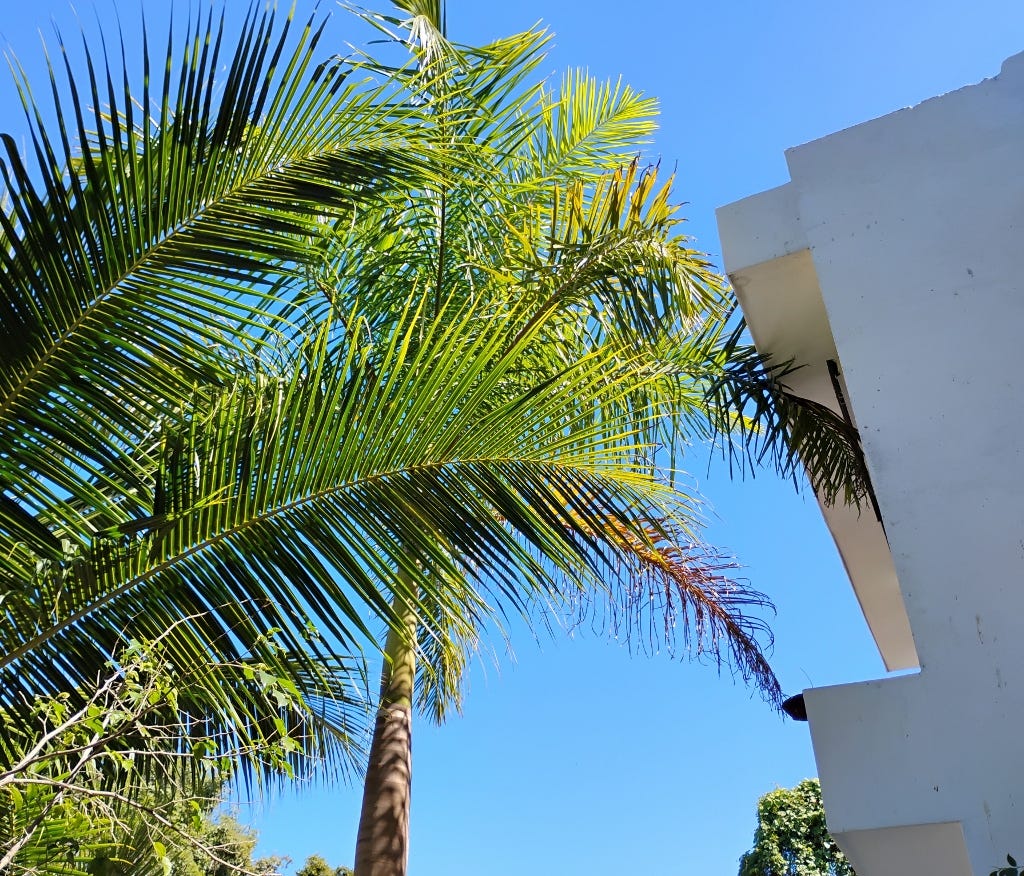
What is unique yet universal in this particular sky with its robin egg blue? What is both particular and ubiquitous, like these palm fronds and banana leaves, in their luminescent green?
What is worth considering in this latest iteration of a recurrent theme, the daily routine, the slice of paradise, the moment of love and bliss reserved by inherent tension from the world of flooding and disease?
Out there the “news” clamors for attention, driving clicks and subscriptions, ramping up social and political engagement, whipping up storms of controversy like rogue weather systems controlled from on high.
In the ancient days they called them gods and goddesses. Today they convene in Davos—not Olympus, but the mechanism is the same: deus ex machina. Claiming to save the day, yet disguising true motives to control—for their pleasure, entertainment, profit, mollified pain.

Today I put aside the controversies and conspiracies, already having done the research, traced the treason, tracked the substitutions of coercion for truth.
Today I lean on daily practice, once again rolling the imperfections of this tormented world into smooth paperwhite space; marking the passage of troubled time with inky increments of tally-marks, citing the instances or sprinkling details to flavor the gist.
If the soup proves unpalatable, throw it out.
If the bums are stupid enough to flaunt common sense in their plea for idiocracy, let them fail spectacularly.
To wit: the rumors of brain-eating disease with 75 percent fatality; or the law-coded certainty of the Great Taking; or the imminent or eventual collapse of every supposed safe haven. Or the shallow roots of whatever serves to nurse the illusion of self-sufficiency, whether on scale of wilderness homestead, or provincial (Alberta) autonomy.
Then comes the call to get into the sun while it shines.
And to cling to civilized comforts while they still stand: hot water for bathing and laundry and dishes. Heat for the cold months, electricity or natural gas for cooking. Internet for connection and communication. But as ever, no definitive safe haven, no ultimate security; no guarantees, no returns.
Before Gentrification
The beach with its warm, turquoise waters, shallow and calm and perfect for swimming, is practically deserted. Up the coast the resorts are full of tourists, but this location is a four-hour detour by bus or van, and there are no night clubs here. Cruise ships dock here two days a week, and the gaggle from Florida or Boston trundle to the malecon by golf cart or taxi, buy a few curios and sip margheritas, then depart for other ports of call.
Yet, as I wander the back roads behind our guesthouse, newly paved, there is construction everywhere. From small villas to high-rise condos, block after block reaching into the reclaimed mangrove swamps. Heavy equipment stands row on row alongside new excavations, crews laying out foundations, side roads ribboned off from public access.
The news announces suspension of permits for the megadevelopment, but our guesthouse has signed a contract next year to house new construction workers. So all it will take, we suppose, is a few well-placed payoffs to get the wheels rolling again, sideline the opposition groups, marginalize the ecosystem concerns, satisfy the locals that they’ll get their cut.
Then the likes of us will be priced out of the market. We’ll have to scour the maps for more remote beaches, accommodations without websites, roads still with potholes. We’ll park our north-white skins on rockier shores, wade past reefs of sargassum, and mix our own refreshments, far from the amplified noise from the exclusive-access beach clubs.
Who’s complaining? We could always just stay at home, engaging in local or national politics, watching our mouths and counting our untaxable assets, as the February rains persist, thankful it’s not snow. Our cats will thank us for our loyal company. Our stay-at-home friends won’t be jealous, counting the months of rain. Our kitchen utensils, curated over years to personal taste, will serve us dutifully, our familiar beds giving comfort in our winter slumbers.
The high rollers will enjoy these pristine waters in their turn, before despoiling it with their thousands of plastic water bottles, their bilge from seaside hotels, their decibels of so-called music, as they burn their buttery bodies lobster pink.
Their end is coming soon too, in its turn, as the big fish bankrupt them with the latest pump-n-dump, too-big-to-fail catastrophe. The little fish will scatter to lesser known shoals, to feed on the detritus, spiced generously with microplastics. Our little lives will play out on the edges of the major tides, unaccounted, unremarkable.
We can say we were here, back in the good old days, before gentrification. Before the great reset, before the great taking.
When we owned nothing, and were happy.
not sure about the great reset and being happy and not owning anything...or being accountable...for doing or not doing It is nice to be in Mexico...go visit P.Vallarta and attend the Anarcapulco event..Feb-27th
Thoughtful reflection on disconnection and impermanence. The contrast between needing internet for modern life yet finding peace without it captures something essential about our current moment. Watching gentrification unfold in real-time from the position of a visitor adds an intresting layer, since we're simultaneously benefitting from accessibility while knowing that access will inevitably price us out. The Greenland reference works well as a metaphor for reset and renewal.