
Democratic Socialism
a reactionary critique

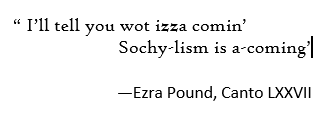
Reading Pound’s quip triggers an impulse, lately dormant in my reclusive psyche, to weigh in on the phenomenon of socialism as it currently manifests in the political landscape. Take it not as any pretense to authority or expertise, except by observation and impression of what’s at play.
Whether it’s Mamdani’s ascent to the NYC mayoral seat, or the seething bluecheckers on North America’s Left Coast, from sea to sea there are forces at work constantly to assert, “Power to the People.” But what people, and with what consequences?

Ever since the endless “bull sessions” in the college dorm (and fruitless arguments with middle-class parents sneering about those “communist professors whispering in [my] ear”), I’ve been leery of putting too much stock in political theory, whether occupying a stance on the Left or Right.
In my older age, at risk of fitting the stereotype, I find myself more skeptical of those well-meaning cheerleaders for what seems so benign and humane, “democratic socialism.”
Not only the young and idealistic, but also the feminine side of humanity, hard-wired for care and empathy, are those most apt to line up and speak out for socialist policies. Recent decades of full-court press for “diversity, equity, and inclusion” have made “the great replacement” of a predominantly white, straight, traditional culture appear morally mandated. Corporate culture, government messaging at all levels, NGO activism, hyperbolic immigration, and social media groupthink have all converged to that end, with pushback only mounting visibly in the last couple of years.
At its economic core, as well as in the broader appeal to a redistribution of power, socialism is all about giving more to those who have less. And naturally, in any society, the majority will have less, compared to the minority—since nature doesn’t favor uniformity of resources or abilities, but a gradient where a few win over their many competitors.
Democratic Socialism then is the great panacea to overturn Nature’s blind injustice. “It’s not fair!” say all the monkeys when the Alpha hogs the watermelon. And so they get the bold human innovation to band together—casting votes—to seize the watermelon and divide it amongst themselves. With the ringleaders (see: Bolsheviks) getting special bonus portions, for their hard work in overseeing the redistribution and planning banners and commemorative rituals to celebrate and cement the gains of their glorious Revolution.
Obviously this critique can be met with its opposite: denouncing the notorious abuses of Capitalism, Patriarchy, White privilege, Nationalism, Fascism, Authoritarianism, et al. Each critique is well reasoned and buttressed with historical evidence, and/or moral philosophy, to prove the case.
So what is my point here?
Pound’s quip suggests the popular appeal of socialism to the unwashed masses, the downtrodden, the disenfranchised. So it’s a no-brainer when it comes to electoral strategy: simply promise “a chicken in every pot,” “a helping hand to all in need,” and a “merit award to all who apply,” and you’re well positioned to win the most votes. Delivering those chickens, once election is achieved, becomes a thornier problem.
The solution, of course, will be to borrow on the public purse to fulfill those endless promises. Fatal irony: with the resulting hyperinflation, the only ones who profit from the legerdemain are a) the bankers servicing the debt and b) the politicians kicking it down the road while clinging to power.

My solution? Don’t fall for the slogans; but witness the shell game and whom it’s designed to serve—the game’s own designers and managers; its ever-expanding bureaucracy and cult of virtuous gatekeepers.
yes, beware of slogans and who's making them... and if Mother Earth is not included.